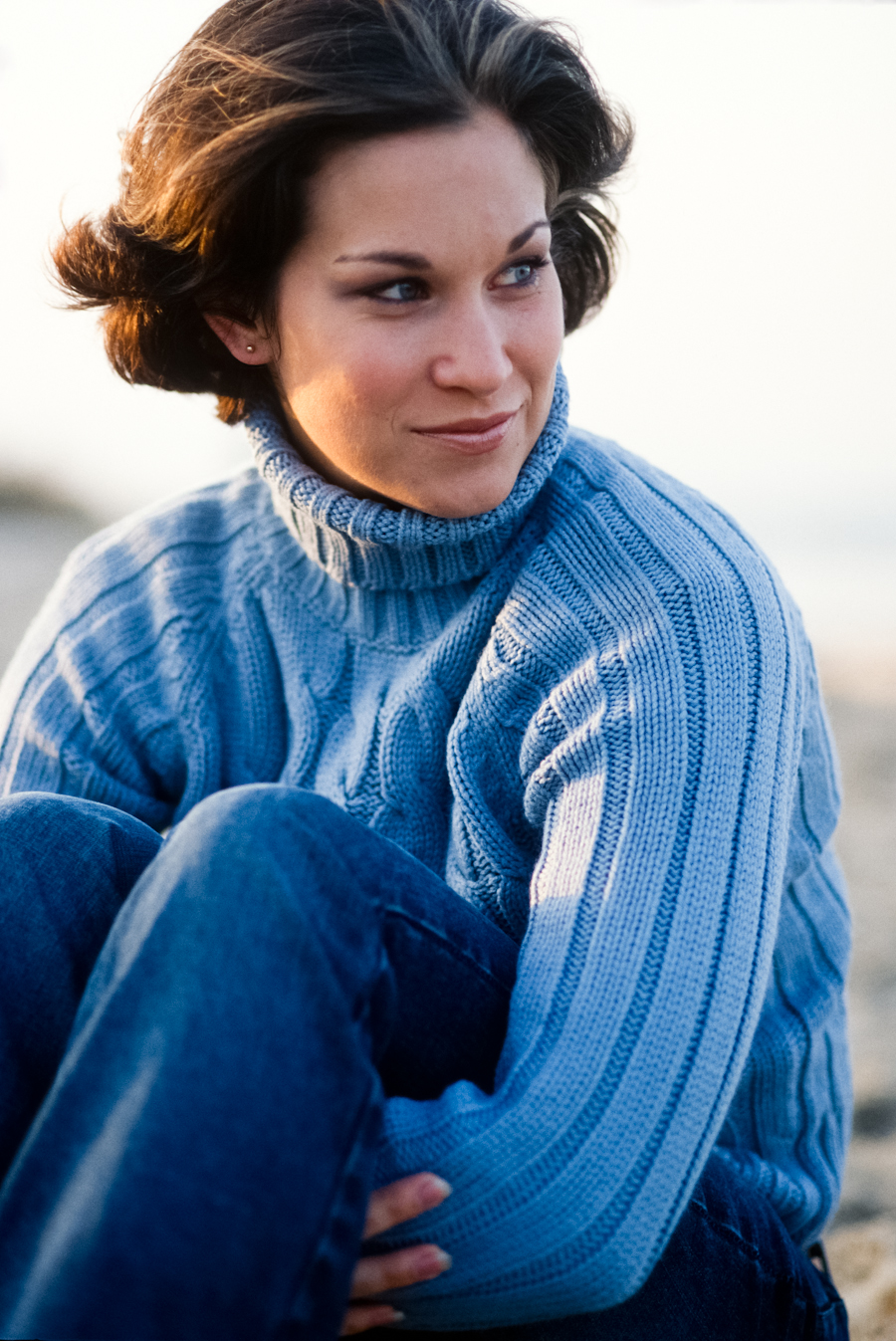
Model “Monica”, Southern Maryland, May and June 2002

Commercial?

Just add text.

Looking back, commercial (commercial-like) photography — all of this was and remains demonstration — doesn’t get more simple.  The photographer brings his bag and tripod; the model brings herself, change of clothes, makeup: done.   If the model has a friend, add a bounce card.

It’s easy to complicate a “shoot” with gear — the studio has been always portable: Vagabond field battery, light stands and lamps, even the changing room that comes in a bag — a one-person tent — but especially in public open space, the more junk hauled along, the greater the hassle.

Hmmm.

I want to do this stuff again!

🙂

# # #

CA – Photography – Technical Note

Editing Screen: LaCie 320 1600×1200

Editing Software: Adobe Lightroom 3.6; Adobe Photoshop CS4; “onOne Presets” Volumes 1 to 3.

Image Standards: Nikon RAW; Adobe DNG; Edited Final: TIFF

Image Sizing: Facebook and Flickr: 900 Vertical; 1600 Horizontal.  Note: for a short period, I was uploading full-sized images, just beneath 6,000-pixels-width, to Flickr, but I’ve settled on the standard noted for the web.   What this means for the viewer is that when the option to see the “original” or “full-sized” image on screen, it’s really about 1/3 the image size available for the file of interest.

One Chance, One Desktop, One Photographer

While my XP-era technology has aged multiple computing generations, it has within the nostalgic traditions of photography — the field is famous for its leading personalities taking great leaps backwards (to wet plates, wooden boxes, FILM, for pete’s sake) to pursue their promotion of the look of having recorded what is to become shared visual memory — rather matured.

I like it.

It and I have already fallen behind.

I don’t care.

The industry has thundered on to the next level — and doubtless has already in hand the level after that — and I’m just hanging out with a couple of old Nikons, digital and film.

Walkabout: Nikon D200, Nikkor 16-85mm VRII, basic filters plus graduated neutral density card (always in the bag), and a carbon fiber tripod.

Portraiture: Nikon D2x, Nikkor manual 105mm f/2.5.

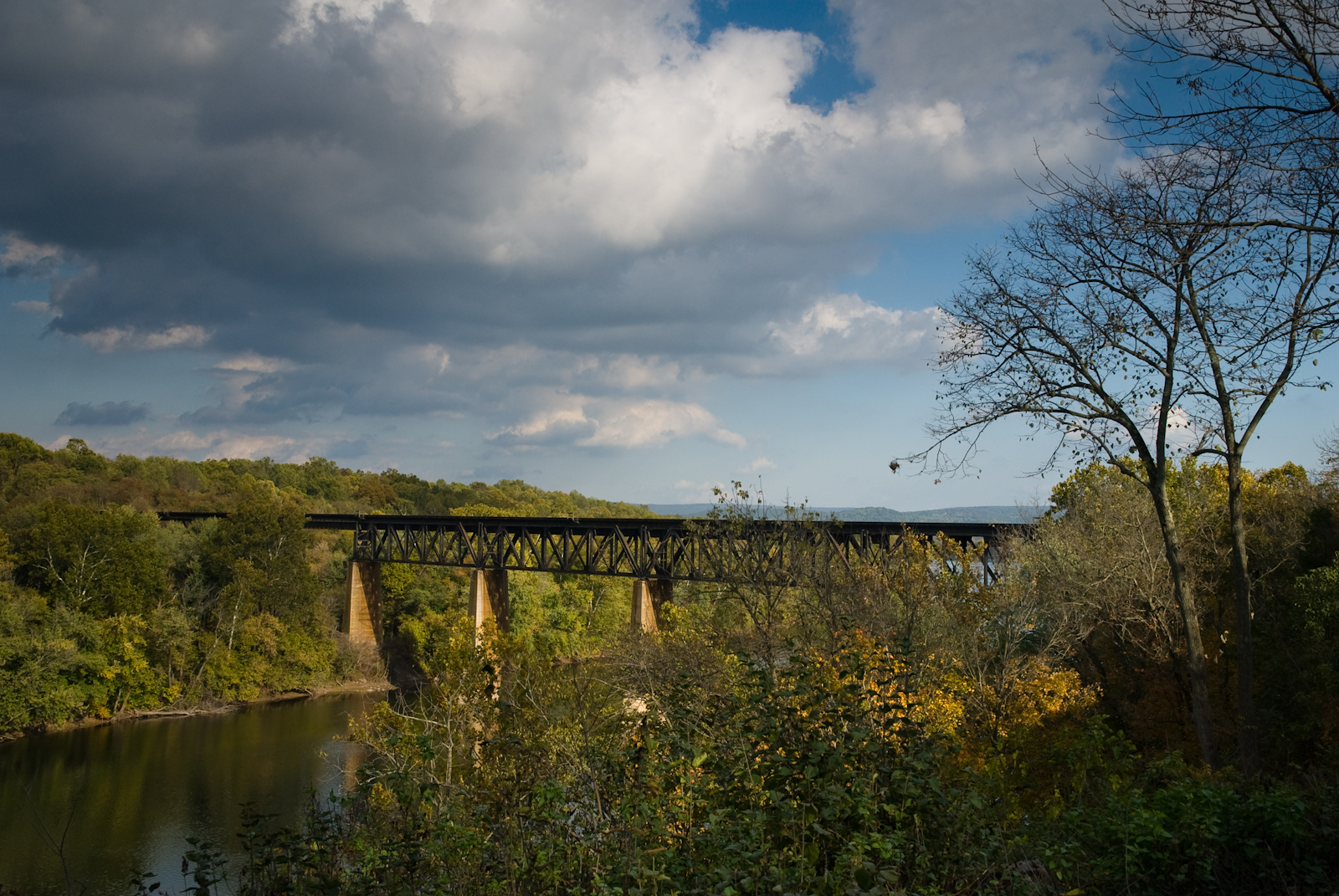
Trestle across the Potomac River  viewed from James Rumsey Monument Park.

Trestle across the Potomac River viewed from James Rumsey Monument Park.

I don’t keep track (as I perhaps should), but the Big Landscape is why I carry the graduated neutral density card.

# # #

Model, “Heidi Blair”, Delaware Shore, October 13, 2001

2001-10-13-d-14-Edit

&


I’ve been winnowing multiple pages from old film-based “photoshoots” down to single slide file pages, scanning two to a few, and doing so roughly, and posting the same here and Flickr (for a while).

Three observations (and I have been here before):

— The women disappear into new lives with new names.  “Heidi Blair” will have an easier time finding the photographer from that long ago autumn day than the photographer (and viewers) will have finding her;

— I see had a “commercial look” back then and doubtless would have enjoyed shooting catalogs, which ambition, of course, compelled the “time-for-prints” shooting.

— Despite the wonders of old “Digital ICE”, Nikon’s dust-and-scratch removing algorithm (coupled with Hamrick’s VueScan software), film remains a little less convenient a medium than digital.  Both of the above were worked using Adobe’s Lightroom 3 and then ported to PhotoShop to clone out the rough edges of the slides.

–Lessons learned since way back then: watch the hands!   Also, leave some margin for cropping down to the subject (and that in addition to what the viewfinder leaves out of the presentation to the photographer).

–One may do a lot without “fill flash”, but in the most sun struck moments, we need either it or scrims.  Related to that: the larger the production — the more one has to carry! — the less the wandering about alleys, church fronts, gardens, and side streets.

Perhaps I am reorienting, taking a break from politics online and reading offline, and recalling what all that stuff in the closet — I get in there and say to myself, “oh yeah, I remember this gadget!” — was about.  Everything has been kept in good condition, including the battery pack and the main camera, a now old D2x, but my inclination, whatever opportunity comes next, is to keep things very simple for a start: one really may do quite a bit with camera, lens, flash, and reflector.

#  #  #

Business, Preparation, Yearning, Learning, Karma, and Plain Dumb Luck

Maryland Commemorative Plaque, Thomas Kennedy and the "Jew Bill", Studio Photography, Hunter Hill, Hagerstown, Maryland, June 17, 2015I’ve described my interest in photography as the “hobby that became an avocation that grew into a profession”.

While part of that narrative involved spending on the nifty cool stuff promoted by the industry’s magazine — I had started with American Photo, and was among the first subscribers (I wish I had kept the first issue) — the enthusiasm, one of three lifetime pursuits, eventually brought calls to shoot weddings, which I did.

Oh the many paths in preparation: for photojournalism (acquired: wide, normal, and long fixed lenses; later: wide-aperture zooms); for portraiture (50, 85, 105 — Nikon classic f/2.5 manual — 180/2.8); for sports (80-200); for events (battery pack); for advertising (everything plus backgrounds, rolls of seamless paper, stands, lamps, umbrellas, softboxes, whatever might be needed, right down to the gaffer’s tape).

Missing: dedicated commercial space.

The bronze plaque, which was heavy and large, was placed on seamless on a dining room table and propped near to vertical by the back of a chair.  Behind the photographer, a dark muslin suspended on the bar of a background stand — with reflective items, one tries to damp the reflections from objects in the vicinity, in this instance, glassware on the glass shelves of a hutch; light source: three 5000K fluorescents with umbrellas mounted on stands; shooting gear: 60mm macro, Nikon D200, tripod.  All may have been easier in a low key (black walls) studio with an easel ready and strobes on tracks — but then how often does one shoot bronze plaques?  And to what specifications?  And does one enjoy that work?

The inner artist here — and the studio — were happy to get the work and to have been prepared to shoot a reflective and three-dimensional object (the text has been cut into the bronze and had to be brought out with directional lighting), but the arrival was rare — and there are other ways to approach technical reproduction.

The client: happy.

On the horizon: more entertainers.

Tresa Paul fronts Grand Point Station at "Blues, Brews, and Barbecue," Capitol Theater Center parking lot, May 7, 2011, Chambersburg, Pennsylvania.

Tresa Paul fronts Grand Point Station at “Blues, Brews, and Barbecue,” Capitol Theater Center parking lot, May 7, 2011, Chambersburg, Pennsylvania.

As with music — and because I play and present music quite well — the talent in intuition remains always suspended in time — it doesn’t disappear.  The body ages; intellectual life becomes more complex in some ways: still, where opportunity appears, whether to take a snapshot or produce one or more panels of art, one chooses an instrument and method — from lens to software to delivery — and goes to work.

I think art-making with modern media always deceptive in how simple it looks to get to something good.  Reality, amazingly, begins with footwear — it’s true!  — and works its way up to the whole toy box (where all the elements supporting the art are kept), the vehicle (sports car, SUV, van, or truck), the business of the business items known to all businesses, the calendar, the computing environment, and, at last, some economics.  By the time a photographer and an object – subject – person – organization get together, an awful lot of issues have been pre-resolved — just the same as having lights and lenses at hand when called — and then I think it still a miracle that everything works all the way through!

# # #